Troubleshooting AirBuddy widget issues
AirBuddy provides two widget systems:
- AirBuddy Desktop Widgets are managed in AirBuddy settings and can appear freely on the Desktop, over the screen saver, and on the Lock Screen.
- Standard macOS widgets use WidgetKit and are added through the macOS widget gallery.
Use the steps for the widget type you’re troubleshooting.
AirBuddy Desktop Widgets don’t appear
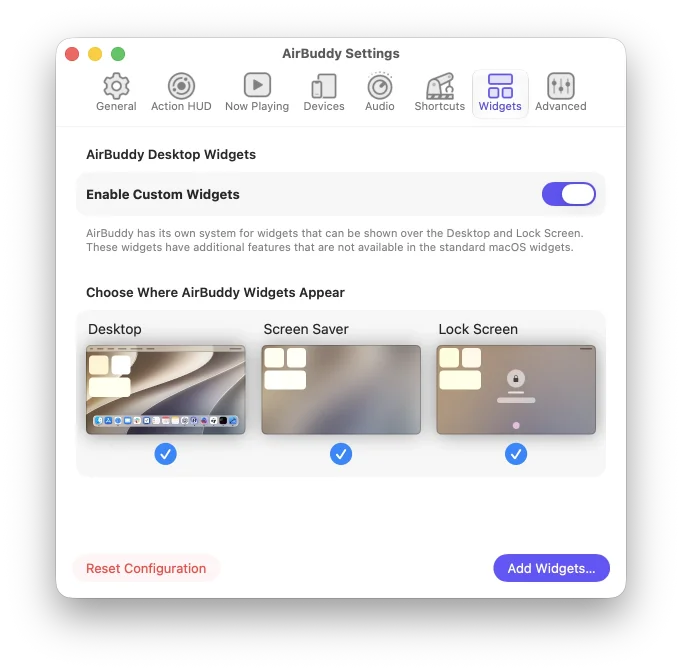
- Open AirBuddy settings and select Widgets.
- Make sure AirBuddy Desktop Widgets is on.
- Make sure the intended presentation, such as Desktop or screen saver, is selected.
- Click Set Up Widgets and confirm that widgets exist in that layout.
Each display has its own layout. A widget configured for one display doesn’t automatically appear on another. You can quickly replicate a widget layout on another display by holding down the Option key while dragging a widget from one display into the other to duplicate that widget.
If the configuration is damaged or you just want to start over, click Reset Configuration in Widgets settings. This deletes every AirBuddy Desktop Widget and its configuration and can’t be undone.
Standard macOS widgets don’t update
Open AirBuddy settings, select Advanced, then click Clear Widget Cache. Remove the affected widget from the Desktop or Notification Center, then add it again from the macOS widget gallery.
WidgetKit controls when standard widgets can refresh, so they can update less frequently than the AirBuddy Dashboard or Desktop Widgets.
AirBuddy isn’t available in the macOS widget gallery
- Make sure AirBuddy is in the Applications folder and has been opened at least once.
- Make sure Enable and launch at login is on in AirBuddy’s General settings.
- Restart the Mac.
- Open the widget gallery and search for AirBuddy again.
For setup and layout instructions, see How to use AirBuddy Desktop Widgets.