How to use the Shortcuts actions provided by AirBuddy
AirBuddy provides actions for the Shortcuts app so you can inspect devices, control connections, change audio and display settings, and build personal automations.
AirBuddy must be enabled in General settings for its actions to work. Depending on the system version, actions may be grouped under AirBuddyHelper in the Shortcuts app.
Device information actions
Use AirBuddy actions to get the device list, a device’s current state, battery information, detailed headset state, installed firmware, the latest known firmware, and Spatial Audio state.
Results can be passed to conditions, notifications, files, and actions from other apps.
Connection and audio actions
Available actions include:
- Connect or disconnect a headset
- Connect or disconnect a paired Bluetooth device
- Get or set Spatial Audio mode
- Set Audio Input Lock and its preferred input device
- Transfer peripherals to another Mac with Magic Handoff
- Hijack peripherals from another Mac with Magic Handoff
Display actions
AirBuddy includes actions to get or set True Tone, Night Shift, Dark Mode, and display brightness.
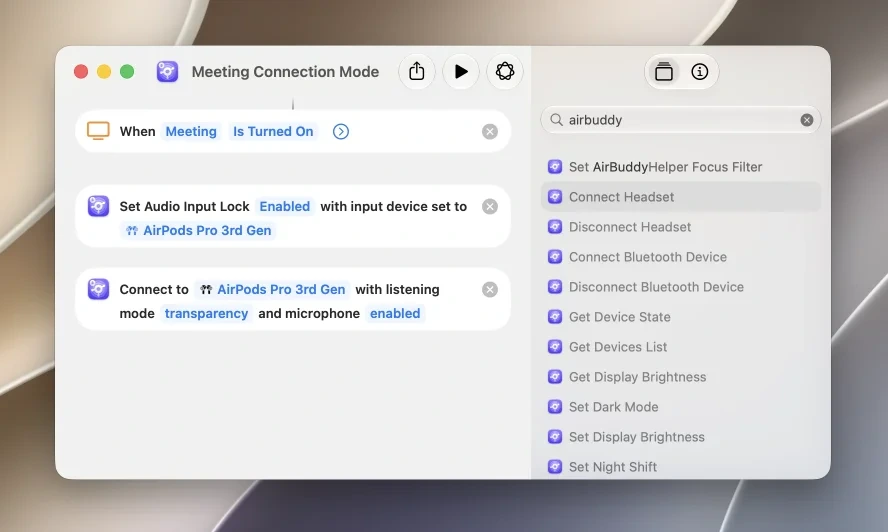
Replace Connection Modes with an automation
AirBuddy 3 no longer includes Connection Modes. You can recreate the same kind of setup with a personal automation that runs when AirPods connect, then uses AirBuddy actions to configure the microphone, listening mode, Spatial Audio, or other settings.
Global keyboard shortcuts
AirBuddy settings also include a Shortcuts section for actions that you want to invoke directly from any app. These can open the Dashboard or Magic Handoff picker, connect the nearest or favorite headset, toggle microphone input, change listening or Spatial Audio modes, bring Desktop Widgets forward, toggle display features, show the Now Playing HUD, and toggle Audio Input Lock.
For scripting workflows, see How to automate AirBuddy with AppleScript.